
Citric Passivation System
Precision Cleaning and Citric Passivation Solution
Manufacturers across aerospace, automotive, medical and industrial sectors are increasingly adopting citric acid passivation processes for stainless steel. During the manufacturing of stainless-steel components, free iron contamination from machining, stamping, forming or handling can compromise performance, leading to rust and corrosion. A well- engineered citric acid passivation system removes that contamination and restores the protective chromium oxide layer that gives stainless steel its corrosion resistance. Zenith Ultrasonics designs and builds citric passivation systems for production environments where process consistency, reliability, and integration with the manufacturing line are essential.

Made in the USA

Custom Engineered Solution

Comprehensive Warranty
Get In Touch
What is Citric Acid Passivation of Stainless Steel?
Citric passivation of stainless steel is a controlled chemical process that removes free iron from the surface of stainless components. The chromium-rich oxide layer at the stainless-steel surface that makes it corrosion resistant can be disrupted due to machining operations. Free iron left in place corrodes and the visible result is rust staining on materials. Here are steps involved in this process:
- Citric passivation of stainless steel removes free iron through an acid-dissolution process.
- The process involves cleaning the parts to remove oils and soils. After this, parts are immersed in a heated citric acid solution. The acid selectively attacks free iron without significantly affecting the chromium content of the alloy.
- After passivation, the surface is rinsed and allowed to re-passivate, building up the protective oxide layer through exposure to oxygen.
- Stainless steel passivation by citric acid is now specified across a wide range of industries and recognized under ASTM A967.
- In a production environment, each of these steps are controlled. Factors such as concentration, temperature, immersion time, and rinse quality affect the end results.
- The passivation process fits naturally into multi-stage aqueous cleaning lines and can be fully automated to support production volume.
Zenith’s Citric Passivation System: Process Stages
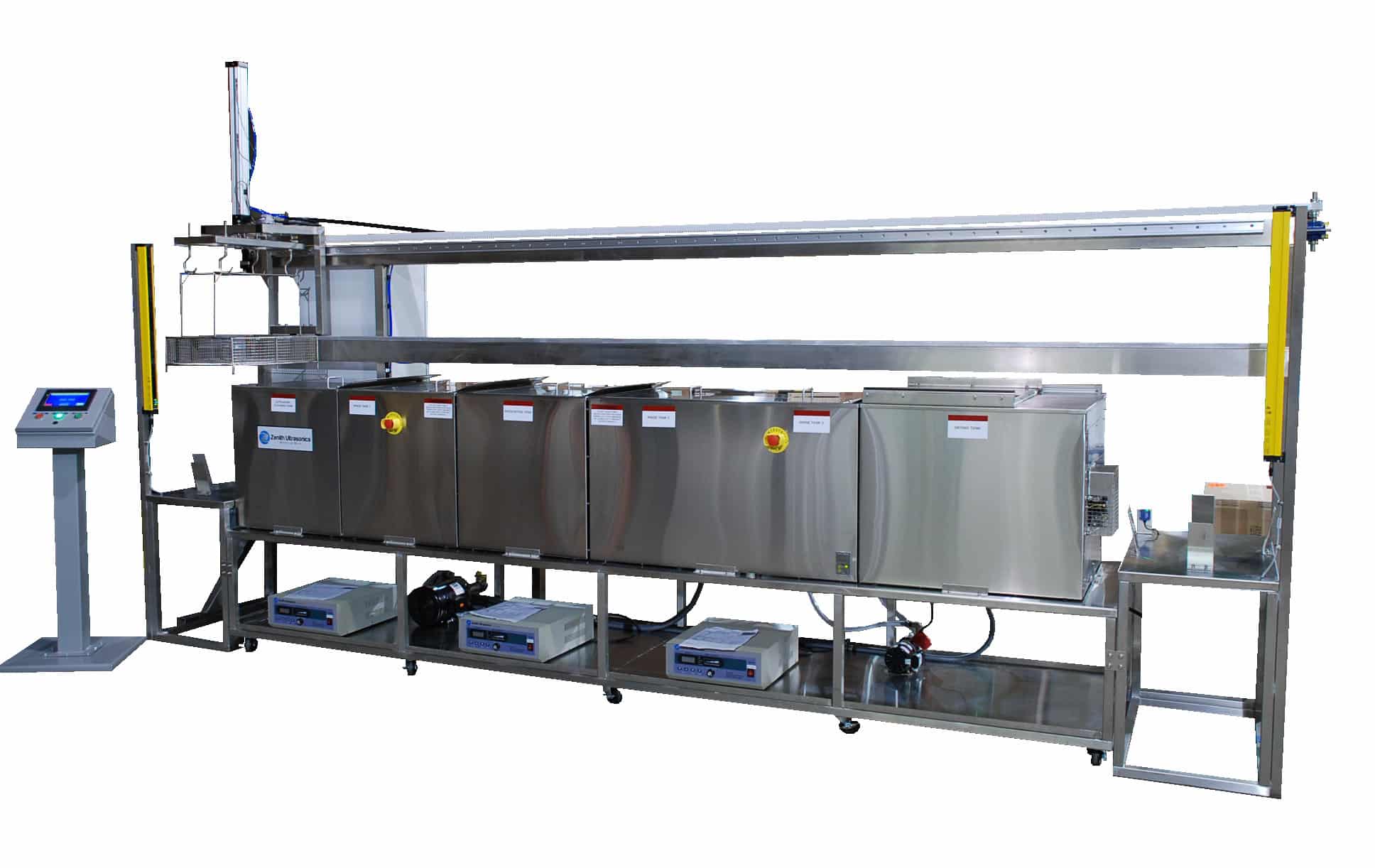
At Zenith, we design citric passivation systems for production environments. Each system is engineered around the specific parts being processed, the production volume, the facility layout, and the cleanliness specification of the client. A complete citric passivation system includes more than the acid stage. A properly engineered system accounts for every stage the part passes through. Here are the typical process stages.
- Pre-Clean and Degrease: Parts arriving at the passivation line carry machining oils, coolants, drawing compounds, and other residues that may interfere with passivation chemistry if not removed first. The pre-clean stage strips these contaminants using aqueous detergent chemistry appropriate for the part material and contamination type. This is where ultrasonic energy is frequently incorporated to address complex geometries and blind features. A clean part entering the passivation stage is the foundation of an effective repeatable process.
- Citric Acid Passivation: The passivation stage operates within defined parameters. Acid concentration, bath temperature, and immersion time are controlled to meet the specification requirements. Generally, the cleaned parts are immersed in a temperature controlled citric acid bath (typically 4–10% concentration at 120–160°F) for 20–60 minutes. The components are regularly monitored to ensure the solution does not dry out prematurely, as this would impact the passivation process. Zenith’s systems incorporate process controls that maintain these parameters within specified limits throughout the production run.
- Dual Final Rinse: After the dwell time, the components are rinsed with clean water to remove any citric acid residues. Water quality at the final stage directly affects the final surface condition.
Zenith’s Citric Passivation System Features
Zenith’s citric passivation systems are built and configured for industrial production. Here are some key features of our citric passivation systems.
- Standard or Custom Tank Sizes: Custom tank sizing accommodates part dimensions and production batch requirements. From small precision components to large fabricated assemblies, tank dimensions are selected to fit your largest part and your required batch size.
- Ultrasonic Enhanced Uniformity: Zenith’s integrated ultrasonic agitation drives the citric acid into blind holes, threads, and complex geometries that static immersion tanks cannot simply reach.
- Material Handling Options: Material handling options includes manual loading, hoist-based transfer, automated gantry systems, or conveyorized lines. We match the handling method to your throughput and floor space.
- Process Control: Process control systems maintain bath temperature, concentration, and cycle timing. Parameters such as temperature control, timed cycles, digital monitoring, and operator interfaces allow repeatable operation.
- Filtration and Fluid Management: Filtration and fluid management equipment extends bath life and reduces operating costs. We integrate filtration, oil separation, and fluid management features to extend bath performance and maintain consistency.
- Production Line Integration: Our systems can operate as standalone units or integrate into existing manufacturing lines. We consider upstream cleaning and downstream inspection or packaging.
Applications and Industries
Our citric passivation systems process a wide variety of components, all of which share the common requirement for a clean, corrosion-resistant stainless-steel surface that adheres to stringent specifications.
- Aerospace Components: Citric passivation of stainless steel is applied to fittings, brackets, housings, and precision-machined parts. In this sector, surface cleanliness and process traceability are essential requirements, not optional preferences.
- Automotive Parts: Citric passivation systems are employed in the production of stainless-steel components such as fuel system parts, exhaust hardware, sensor housings, and braking system components. In these applications, maintaining consistency across high production volumes is a critical operational requirement.
- Medical and Precision Components: Surgical instruments, implantable device components, and precision assemblies require passivation chemistry and process controls that meet the specific standards governing medical device manufacturing. Zenith has experience building systems for this sector.
- Machined and Stamped Parts: Job shops and captive machining operations processing stainless steel on a regular basis benefit from in-house passivation capability. The ability to passivate parts on-demand, without the lead time and cost of outsourcing, supports production scheduling and quality control.
- Industrial Stainless Assemblies: A wide range of industrial applications requires passivated stainless-steel surfaces to ensure optimal performance in service. Components such as valves, pumps, food processing equipment, and general industrial fabrications benefit from passivation prior to shipment. Our systems are designed to meet the production volume and surface quality requirements essential for these applications.
Process Control, Quality and Compliance
A passivation process that varies between shifts, between bath loads, or as bath chemistry ages is not a controlled process. Variability in passivation produces variability in surface quality, and in regulated industries, and this is a compliance issue. This is how we address the issue through the system design.
- Repeatability: Our citric passivation systems incorporate controls for the process parameters that determine passivation quality. The same input conditions produce the same output. Automated dosing systems maintain chemistry within the specified range as the bath is consumed.
- Suitability for Regulated Industries: We have experience building equipment for aerospace, military, and high-technology manufacturing. Process control, validation support, and documentation are part of that experience. For aerospace, medical, defense, and other regulated industries, the ability to document process conditions for each production lot is frequently a client or regulatory requirement.
- Alignment with Industry Standards: ASTM A967 provides the governing standard for passivation of stainless steel, including testing methods for verifying passivation quality. ASTM A380 covers cleaning and descaling of stainless-steel equipment. Zenith systems are designed with these standards as the process framework.
Safety Guidelines for Operating Zenith’s Citric Passivation System
Although our citric passivation systems are known to assure process efficiency, following these precautions will help ensure operator safety and process integrity.
- Wear Personal Protective Equipment: Always wear chemical-splash goggles, acid-resistant gloves, and a lab coat or apron when handling citric acid solutions.
- Ventilation: Ensure to place the system in a well-ventilated area to avoid inhalation of fumes generated during the passivation process. This can be improved by purchasing our optional automated tank covers which keep tanks closed when not in use and greatly reduce fume release into the work area.
- Monitor Bath Temperature: Never exceed the recommended temperature range. Overheating may cause excessive fuming or reduced passivation effectiveness.
- Chemical Handling: Follow proper procedures for handling and disposing of citric acid and other chemicals used in the system.
- System Calibration: Ensure regular calibration of the system to maintain accurate passivation results and avoid system malfunctions.
- Emergency Procedures: Familiarize operators with emergency shutdown procedures and the location of emergency equipment, such as eyewash stations, safety showers, etc.
- Training: Provide thorough training to all personnel on safe system operation and emergency protocols.
Ready to Discuss Your Passivation Process?
If you are evaluating a citric passivation system for a new production line, replacing an existing nitric acid process, or building passivation capability into a manufacturing operation for the first time, Zenith applications engineers can work through the specifics with you.

Download the ACS Brochure
Press the button below to access the ACS brochure which will provide you all of the details you need regarding these ultrasonic automotive parts cleaners.
Download
Looking for something else?
Our Product Page will provide you with general descriptions and links to all of our ultrasonic cleaning products. A great place to start when you don’t know what you need.
Learn More
Smaller Automotive Parts Cleaners
Zenith also offers smaller table-top systems that can also be used to clean automotive parts. Click the link below for additional information.
Learn MoreFAQ
o Safety: Citric acid passivation of stainless steel is safe and possess no danger to people when handled with good manufacturing practices. It is non-toxic and biodegradable, making it safer for people and environment.
o Corrosion Resistance: Citric passivation creates a denser, more uniform oxide layer compared to nitric acid, delivering measurably better salt spray and humidity resistance on 300 and 400 series stainless steel.
o Production Efficiency: Citric acid passivation requires less stringent waste disposal procedures, reducing overall processing and compliance costs.